Loading...
Searching...
No Matches
GameInstance Class Reference
Singleton with various game properties and functions. This class also manages game subobjects. More...
#include <GameInstance.hpp>
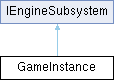
Inheritance diagram for GameInstance:
Public Member Functions | |
| virtual void | Resolve () noexcept override |
| void | LoadSubobjects () |
| World * | GetWorld () const |
| Gets world object. | |
| PlayerController * | GetPlayerController () const |
| Gets player controller object. | |
| void | RequestShutdown () |
| Requests to queue engine shutdown. | |
| Public Member Functions inherited from IEngineSubsystem | |
| virtual void | _BeginPlay () |
Static Public Member Functions | |
| static GameInstance * | get () |
| Gets singleton instance. | |
Public Attributes | |
| bool | _isMainTickRunning |
| float | FRAMES_PER_SECOND |
| Global FPS constant for screen refresh. | |
| int | MS_REPEAT_THRESHOLD |
| Threshold to wait for input completion in milliseconds. | |
Detailed Description
Singleton with various game properties and functions. This class also manages game subobjects.
Set global constants and get objects using the instance.
Subclasses must be registered using SET_DEFAULT_SUBCLASS.
Definition at line 36 of file GameInstance.hpp.
Member Function Documentation
◆ get()
|
static |
◆ Resolve()
|
overridevirtualnoexcept |
Implements IEngineSubsystem.
Definition at line 51 of file GameInstance.cpp.
◆ LoadSubobjects()
| void GameInstance::LoadSubobjects | ( | ) |
Definition at line 43 of file GameInstance.cpp.
◆ GetWorld()
| World * GameInstance::GetWorld | ( | ) | const |
◆ GetPlayerController()
| PlayerController * GameInstance::GetPlayerController | ( | ) | const |
Gets player controller object.
- Returns
- player controller object
Definition at line 49 of file GameInstance.cpp.
◆ RequestShutdown()
| void GameInstance::RequestShutdown | ( | ) |
Requests to queue engine shutdown.
Engine will be shutdown at the end of the current tick when this function is called
Definition at line 39 of file GameInstance.cpp.
Member Data Documentation
◆ _isMainTickRunning
| bool GameInstance::_isMainTickRunning |
- Warning
- NEVER MODIFY THIS VALUE DIRECTLY
- See also
- RequestShutdown()
Definition at line 63 of file GameInstance.hpp.
◆ FRAMES_PER_SECOND
| float GameInstance::FRAMES_PER_SECOND |
Global FPS constant for screen refresh.
- Note
- Reassignment after global BeginPlay has no affect on refresh rate
Definition at line 68 of file GameInstance.hpp.
◆ MS_REPEAT_THRESHOLD
| int GameInstance::MS_REPEAT_THRESHOLD |
Threshold to wait for input completion in milliseconds.
Terminal limitations make input states difficult to implement. A delay is used to wait for marking an input as complete. Higher values will make state based movement more smooth, but increase latency. Lower values will decrease smoothness but maximize input delay. A value of 195 is recommended for the optimal smoothness-to-latency ratio
- Warning
- A value of 0 will remove input state logic and minimize latency. However, inputs binded to states other than InputType::Triggered will never be fired
- Note
- This setting also affects boolean input latency (single button press).
Definition at line 79 of file GameInstance.hpp.